
Behind the Bean:
Decoding Green Coffee Grading &
Quality Metrics in Indonesia
Water Activity, Screen Size, and Bean Density
What Defines Green Coffee Quality?
When you hold a bag of specialty green coffee, what you are looking at is the result of months of agricultural care, precise post-harvest processing, and rigorous quality control. For buyers, roasters, and coffee enthusiasts, understanding green coffee grading and quality metrics is essential. It bridges the gap between how a coffee looks in the lab and how it tastes in your cup.
In this guide, Coffee Bean Nusantara breaks down how coffee is measured, evaluated, and graded globally, with a special look at how Indonesia—one of the world’s premier coffee origins—ensures top-tier quality for the international market.
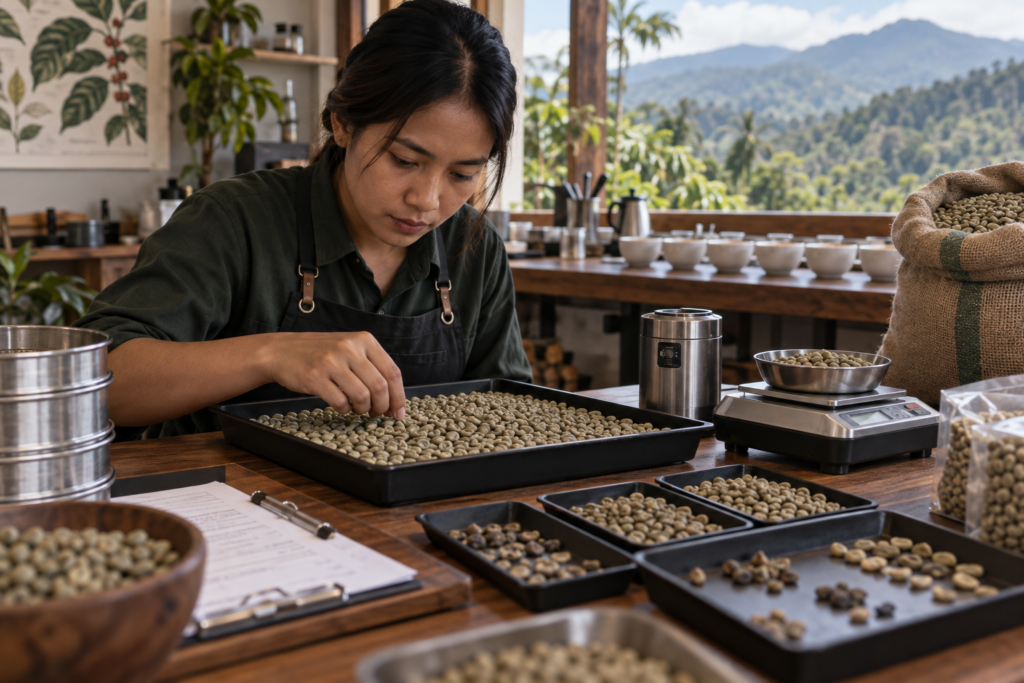
Key Green Coffee Quality Metrics
& Water Activity
The ideal moisture content for specialty green coffee is strictly between 10% and 12%. If beans are too wet (>12.5%), they are prone to mold and fungal growth during shipping. If they are too dry (<10%), they become brittle, lose vital aromatic compounds, and shatter during roasting. Water activity is equally critical, with specialty targets kept below 0.70 to ensure stability across long ocean voyages.
(Bean Uniformity)
Coffee beans are sorted by passing them through standardized metal screens with specific hole diameters measured in fractions of an inch (64ths). For instance, a Screen 18 bean measures 18/64 of an inch. Uniform sizing ensures that every bean roasts evenly, preventing burnt small beans or under-roasted giant beans.
The presence of flawed beans or foreign matter drastically impacts flavor clarity. Graders look for physical flaws ranging from broken beans and insect damage to severe defects such as moldy or “full black” beans.
The Indonesian National Standard (SNI)
Defect Value System
Indonesia has implemented export standards for coffee beans based on a defect value system since 1990, replacing the Triase system (Weight by Weight). The current coffee bean quality standard is the Indonesian National Standard (Standar Nasional Indonesia), or SNI Number 01-2907-2008 for Green Coffee Beans, which has undergone several revisions. These revisions consider the development of the global market and international requirements, alongside partial adoption of the ICO (International Coffee Organization) Resolution No. 407 on the “Coffee Quality Improvement Program”.
GENERAL QUALITY REQUIREMENTS. The moisture content of coffee beans is no longer differentiated based on the type of processing—wet or dry processing—but remains the same, at a maximum of 12.5%.
SPECIAL QUALITY REQUIREMENTS Based on Bean Size. The bean-size criteria are the same, using round holes for all types of coffee beans and based on the processing method. However, Robusta’s sieve passability is differentiated based on the processing method—wet or dry.
Grade 1 – Maximum number of defective values: 11
Quality 2 – Total defect value: 12 to 25
Quality 3 – Total defect value: 26 to 44
Quality 4a – Number of defective values: 45 to 60
Quality 4b – Total defect score: 61 to 80
Quality 5 – Total defect value: 81 to 150
Quality 6 – Total defect value: 151 to 225
Note: For Arabica coffee, Grade 4 is not divided into subgrades 4a and 4b. In general, Indonesian Arabica coffee is exported in Grade 1, while approximately 60% of Robusta coffee is exported in Grade 4, around 30% in Grades 5 and 6, and approximately 10% in Grades 1 and 2.
Coffee Bean Nusantara ships multiple G1 lots each season, including Arabica Gayo Grade 1 green coffee beans. Getting there consistently starts with correctly identifying which defects count. Many Indonesian Grade 1 lots—especially traditional wet-hulled origins such as Sumatra Gayo or Mandheling—land comfortably in the 80.00 to 84.99 range (“Very Good” specialty). They feature rich, earthy, chocolatey, herbal, and low-acidity profiles.
Primary vs Secondary Defects in Indonesia
Primary defects are severe flaws. They can ruin the taste of the coffee completely—making it taste sour, rotten, or medicinal—or damage expensive roasting equipment.
In Indonesia, coffee grading follows the official national standard (SNI 01-2907-2008). To determine the grade of a coffee batch, quality-control workers take a 300-gram sample of green beans, spread them out, and manually count the defective beans and foreign objects.
Under Indonesian standards, each primary defect usually counts as one full point or higher:
- Full Black Bean: A bean that has turned completely black because it died on the tree or fermented for too long. One black bean equals one full defect point.
- Sour Bean: A bean that has over-fermented and developed a reddish-brown or yellowish color. It tastes sharply acidic and vinegary when brewed.
- Moldy or Fungus-Damaged Bean: Beans covered in white or green mold. This introduces dangerous toxins and unpleasant moldy flavors.
- Foreign Matter: Objects that should not be present in the coffee, such as stones, twigs, soil, or pieces of metal.
- Note: A large stone or heavy twig is treated as a severe defect and can contribute five defect points immediately.
Secondary Defects (The “Minor Flaws”)
Secondary defects are less severe. They may affect how the coffee looks or cause it to roast unevenly, but they do not completely destroy the flavor profile. Because they are less harmful, they count as fractions of a point—for example, 1/5, 1/2, or 1/10 of a point. This means a few of them can be present before they affect the grade.
- Broken or Chipped Beans: Beans cracked or smashed during milling. Five broken beans equal one full defect point, because each contributes one-fifth of a point.
- Insect-Damaged Bean: A bean with tiny pinholes where insects burrowed inside. Ten single-hole beans equal one full defect point, because each contributes one-tenth of a point.
- Immature or Unripe Bean: A flat, shriveled, whitish bean picked before it was fully ripe.
- Parchment Skins: Leftover dry husk flakes attached to the bean.